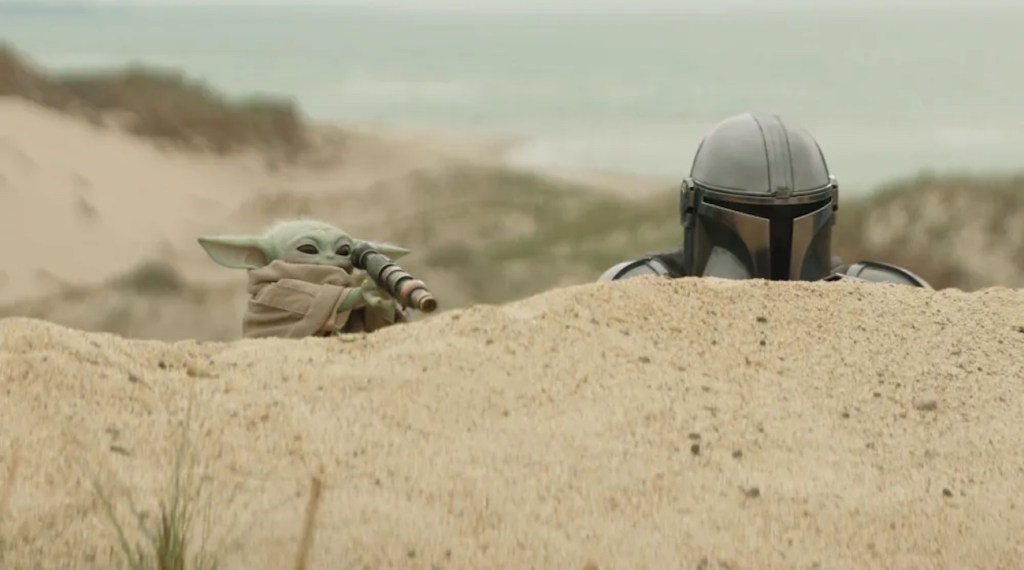
Saying a movie spun out of a TV series should have stayed a TV series feels like an easy, sometimes even lazy, criticism. I thought that might apply to The Mandalorian and Grogu. Yet it’s probably a fair gripe.
The Mandalorian and Grogu doesn’t utilize what made the series special, probably because it’s limited to a two-hour running time rather than eight episodes of TV. It’s also limited by not being allowed to step outside the show’s boundaries into the larger Star Wars mythology. So yes, rather than being made into a movie, this should have been Season 4 of the series. (And hopefully, with more episodes, it would have been better.)
What made The Mandalorian series so enjoyable as a Star Wars fan is that it expanded the universe that we followed in the movies. It made the mythology feel bigger against the backdrop of the war between the Rebellion and the Empire, building on the concepts of the Jedi and the Force. It also added more to ideas that were intriguing yet not crucial to the overall story — characters such as Boba Fett, his origins, and the society in which he existed.
Yet the world of The Mandalorian could only go so far. It runs into a ceiling. We don’t see the main character, Din Djarin, in the newer Star Wars trilogy. (The series is supposed to take place between Return of the Jedi and The Force Awakens, which allows for a whole bunch of storytelling possibilities.) Grogu, the adorable “Baby Yoda,” was not a part of the most recent films either.
This is despite the revival of the Jedi to battle the re-emergence of the Sith and the dark side of the Force. Maybe that’s a good thing because Grogu wouldn’t be nearly as appealing as an older character. Kind of like teenage Groot in the Guardians of the Galaxy films and Marvel Cinematic Universe. His child-like joy and mischief — along with his cooing and babbling — are what make him so fun.
The Mandalorian was essentially an “adventure of the week” series with Djarin and Grogu going on a mission to collect another bounty and perhaps encounter characters with ties to the Star Wars movies or the animated series created by Dave Filoni. Where are the other Mandalorians like Bo-Katan Kryze? Competing bounty hunters including Cobb Vanth and Greef Karga? (Rest in peace, Carl Weathers.) Even quirky farmers like Kuiil (“I have spoken.”) would be welcome here.
Seeing those characters in live action — or computer-generated animation —added another aspect of fun to the series. It rewarded diehard fans who took deep dives into Star Wars lore. But it also showed less devoted followers that there was so much more to find in these galaxies far, far away.
In that regard, The Mandalorian and Grogu fits right in with the series. Djarin and Grogu are working for the New Republic (previously the Rebellion), hunting down warlords who went into hiding after the fall of the Imperial Empire. The story quickly presents ties to past Star Wars mythology with the AT-AT walkers attacking our heroes as they pursue their bounty. It’s a fun cold open.
Unfortunately, the plot continues to look back at the past. And because of that, the larger story doesn’t really move forward. Djarin and Grogu are assigned to find and rescue the son of Jabba the Hutt, Rotta. That will lead to new information on tracking down another Imperial commander.
Is there more to the plot from there? It doesn’t really matter. The Mandalorian and Grogu isn’t interested in growth. It doesn’t present any questions intriguing enough to make us want to see more adventures with these two characters.
If you ever wondered what a muscular Jabba the Hutt looks like, Rotta provides a younger, buff version. He’s also voiced by Jeremy Allen White (The Bear), but there’s nothing special to that. His voice and dialogue are disappointingly normal. We do get to see how these slug-like creatures with no legs move around. A sequence going through Jabba’s palace on Nal Hutta also shows how these things cohabitate, if anyone was curious about that.
Even when the story appears to raise its stakes, those developments don’t add anything. Star Wars mythology told us that the Mandalorians are never allowed to remove their helmets. Anyone who sees their faces has to die. Yet when Djarin’s helmet is easily removed, he barely reacts. Considering what he had to endure to restore his standing among the Mandalorian clan in Season 3 of the series, Djarin would seemingly be more pissed off about that.
Is this because such consequences were already demonstrated in the series? OK, but what if you haven’t watched the show? Taking off the helmet merely seems like an effort to prove that Pedro Pascal is in the movie, portraying the Mandalorian at least part of the time. Maybe 25% of the movie. (At least the credits acknowledge who plays the character on screen most of the time, giving Brendan Wayne and Lateef Crowder their due.)
Disappointingly, there’s no evolution in the relationship between Djarin and Grogu. At one point, Grogu arguably saves his adopted father’s life yet it’s barely acknowledged — not even to recognize how far lil’ Baby Yoda has come from a helpless child to someone who survives and succeeds on his own without his mentor. If Djarin’s progression from mercenary to father figure was a key element of the series, where is the pride he might show in his son?
Perhaps worst of all, we don’t get very much of the comedy that comes from Grogu being a mischievous child — especially in his vital pursuit of a snack — and Djarin being a strict guardian. Cheap laughs? Maybe, but that odd couple pairing is what made the TV series so endearing and enjoyable.
If it turns out that The Mandalorian and Grogu was intended to be a placeholder before a fourth season of the series, then its creative inertness might be understandable. But it also makes this movie a waste of time for everyone involved, especially Star Wars fans. These characters are beloved, but a two-hour film needs to remind us why — or show why, tho new viewers. As much as I hate to say it, this was not the way.

