Note: This article was originally published at Awful Announcing in April 2015.
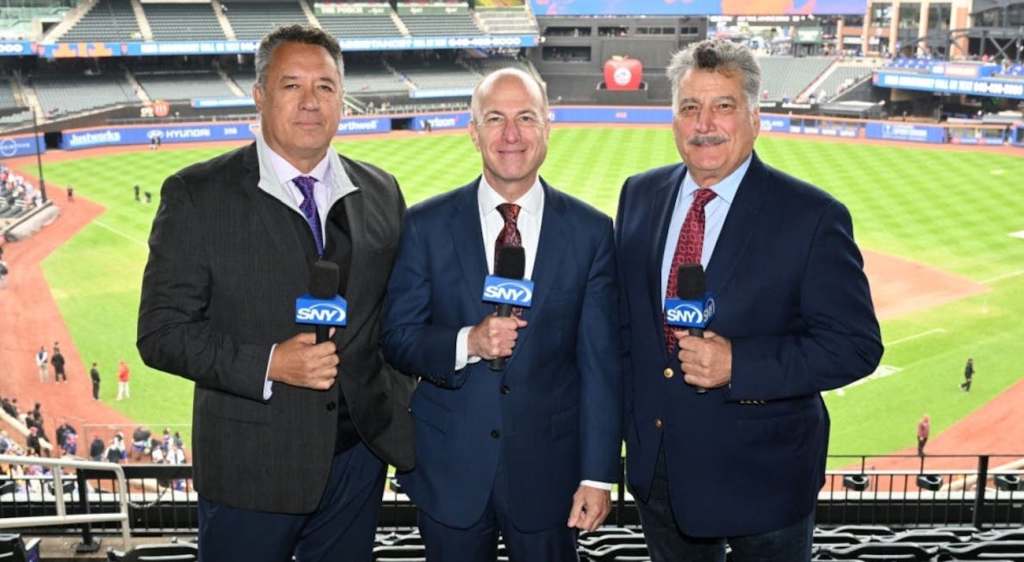
The 2015 New York Mets season will represent the 10th year together for SNY’s (SportsNet New York) broadcast trio of Gary Cohen, Ron Darling and Keith Hernandez. It’s an impressive run, one not typically seen on regional team broadcasts. The success is even more notable, considering how rare three-man booths are on sports television these days.
But the SNY team makes it look easy, with a smooth chemistry and refreshing candor that’s made it extremely popular among Mets fans and considered by many to be the best broadcast booth in MLB. So what has been the key to the trio’s success? How has it worked so well over the past nine years?
“I think the thing that works best for us — and it really is rare in television, especially when you have two players who had great careers — is that we have a very low-ego booth,” said Cohen, who had called Mets games on radio for 17 years before moving to TV.
“What I mean by that is, nobody needs to be the star. You hear it sometimes in other broadcasts, where there’s almost a competition for the microphone, and that’s never the case on our broadcast, even when we have three in the booth.”
A key part to the team’s chemistry is that each man understands his role, which was established early on by Hernandez. In fact, the former Mets first baseman laid the groundwork just minutes before they went on the air for their very first broadcast during spring training.
“I remember Keith poking me and saying, ‘Hey, listen — you do the pitching, I do the hitting,’” recalled Darling. “And simply, in that one sentence, he kind of cured all the ills that happen with a three-man booth.”
But even with those roles defined, there’s still the risk of Darling and Hernandez talking over each other or Cohen having to play traffic cop during the broadcast. Yet early on, and especially after nine years together, the three have developed an unspoken understanding of who should speak and when.
“It didn’t take long, really,” said Hernandez. “At this point, we kind of look at each other. When Gary asks a question, it’s never ‘Who goes first?’ When Ronnie has something to say, I can sense it, and I think when Ronnie feels I have something important to say — whether it’s with my body language — we can sense that. I can’t put a finger on it and say why, but it’s all a part of our process of working so cohesively together.”
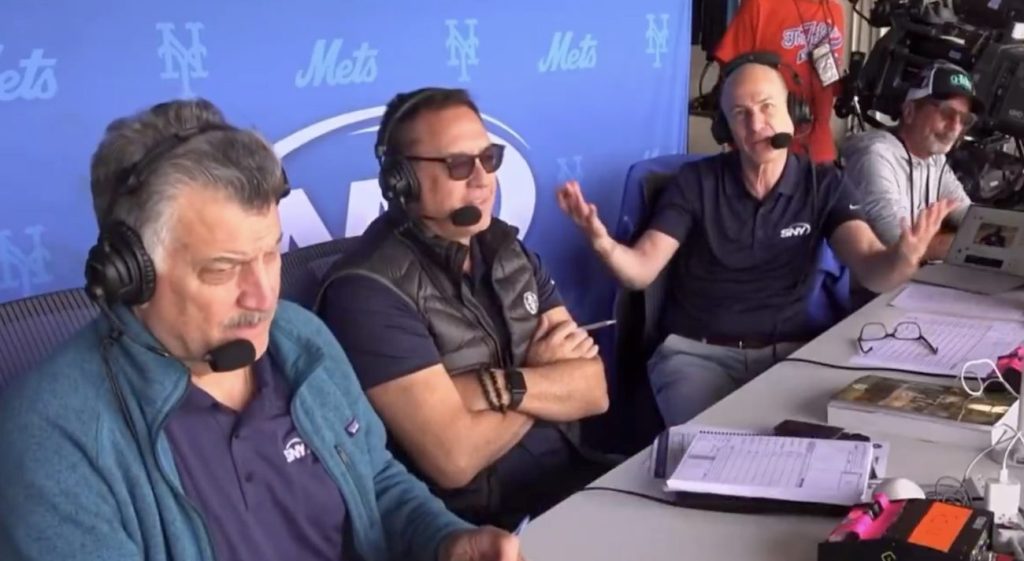
Each broadcaster also makes a point of crediting their on-air success to the people you can’t see or hear on television, producer Gregg Picker and director Bill Webb.
“I cannot tell you how many times I’ve been in the middle of a sentence and I forget a specific word, what’s the appropriate word, and Gregg’s right there,” Hernandez said. “He’ll say the word and I don’t skip a beat in my sentence. But Gregg is also a baseball fan and when we say things that need more, he says, ‘Well, you have to elaborate on that.
“Bill gives us a heads-up sometimes where he’s going with his camera so we can fluidly go right to that. But he has to listen to us too. If we’re talking about [Mets manager] Terry Collins, he has to bring the camera to Terry Collins as we’re talking about Terry. And he has to anticipate where we’re going and what we’re talking about for what he shoots in between the action. So it’s really, really, really a team effort.”
Yet the roles in the booth have also evolved over time. This spring, Darling occasionally took over play-by-play duties while Cohen called Seton Hall basketball games on the radio. Darling suggested himself as a fill-in to SNY executive producer Curt Gowdy Jr., not only to substitute in case of emergency but to break up the monotony that sometimes develops during spring training.
Another evolution from an audience standpoint has been an interest, perhaps even a demand from a certain contingent of the fanbase, in including advanced metrics in the broadcast. So much more information is available now to viewers and broadcasters alike. However, determining what’s pertinent during the telecast and playing to the wider audience at large are factors that have to be considered throughout.
“I think it’s an interesting line, and the line keeps moving,” said Cohen. “The people who are tuned into advanced statistics are generally very intelligent and very vocal. But I don’t think they necessarily make up as large a percentage of the people watching the games as they think they do.”
“When people come up to me and talk to me about the broadcast, I can’t tell you that any person has ever said, ‘You don’t use advanced statistics enough.’ Most of them, they want to know about the players’ personalities. They want to know about how someone improves their batting stroke or throws a curveball. They’re much more interested in the mechanics of the game, the group dynamics and personality of the game, than in a slew of numbers.”
Something else that’s changed during the SNY crew’s nine years in the booth is having its broadcasts available to a much wider audience with innovations like MLB Extra Innings and MLB.TV. And viewers also have a greater voice than ever through social media. Has that resulted in a different sort of feedback from the audience or is it something the team is adjusting toward?
“I am not a Tweeter, or any of that stuff,” said Hernandez. “I don’t get involved in all that stuff. I don’t know why the players do, to be honest with you. But I certainly don’t.”
“I’m not really tuned in with social media all that much,” Cohen added. “I try not to listen to the chatter because I think that can be distracting — just as much for announcers as it is for athletes.”
“I’m definitely a voyeur on Twitter,” Darling said. “I don’t participate on Twitter, but I like being a voyeur because there’s so many good people — Kenny Rosenthal and others — guys who follow the team that I love reading what they have to say, some of the best writers in our sport.”
One development in baseball that’s occurred during the trio’s nine years in the SNY booth which all three agree on is the increasing length of games and slowing pace of play in the sport. The trio are encouraged about the rules MLB is implementing to address such concerns.
“You spend a lot of time just watching things not happen,” said Darling. “To do anything where the pitcher’s moving a little quicker, where the athletes are running out to their positions, where guys are staying in the box, all of those things are just aesthetically better to watch.”
“I hope that the steps Major League Baseball is starting to take have some kind of effect,” added Cohen, “because to me, its product is suffering from the lack of pacing. And it’s certainly had an impact on the broadcasts. No question about that.”
As you might expect from an analyst known for his sharp opinions, who likes that they “have a little edge to our broadcast,” Hernandez has definite thoughts on what’s caused baseball to slow down.
“I think that a lot of the big culprits for length of the games are relief pitchers,” he said. “Those times when you get three changes in an inning, a manager makes three moves. I like the fact they they got a clock on that relief pitcher to warm up and throw his pitches. I can’t tell you how many games are gone through six innings, you’re cruising right along, as soon as the bullpen comes in, they’ll blow it up. It’ll be a three-hour, three-hour-plus game.
“Anything to make the game shorter. Four-hour games are outrageous. Anything over three-and-a-half hours is ridiculous. It just shouldn’t be that way.”
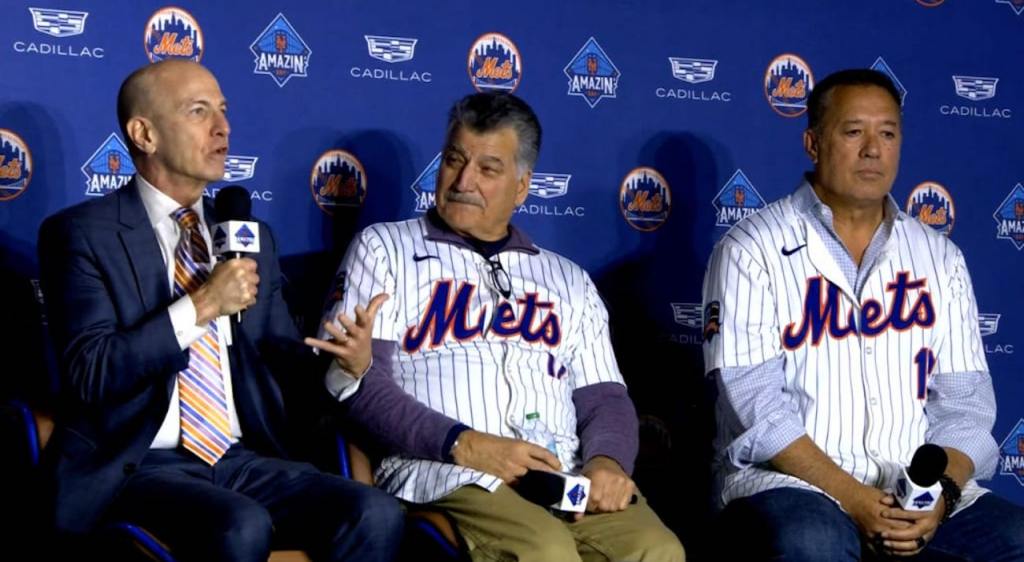
The feeling of camaraderie grows stronger with Cohen, Hernandez, and Darling on the road, especially because the broadcast team is largely on its own away from home. Traveling together for seven months out of the season means spending plenty of time together with one another both in and out of the broadcast booth.
“The announcers, when I played — Ralph Kiner, Tim McCarver and others — it would be routine to have dinner with them or to hang out and sit and talk with them,” Darling explained. “That’s not really the case anymore with today’s athletes.
“I didn’t realize that it was going to be just kind of us and them. The ballplayers, they’ve got their deal. It’s really our crew of five or six guys who travel, we’re the other guys.We know we’re not the players, we know we’re not associated with the team. So we kind of take care of each other and hang out with each other all the time on the road.”
As the SNY crew heads into its 10th year in the booth, that relationship seems stronger than ever and each broadcaster grows more appreciative of how good this combination has been.
“I have to tell you, I’m incredibly fortunate,” said Cohen. “Those guys are so good at what they do. Ronnie has obviously become an elite national broadcaster, and brings such intelligence and such a work ethic to what he does.
“But I think also that Keith is very underrated by a lot of people for the insight that he brings. A lot of people tend to put his curmudgeonly ways first and foremost, which I think is part of his charm and is hilarious, and we have a lot of fun with that. But he knows the game better than anyone else I hear on television. It’s my great fortune to work with those two guys.”
 Ian Casselberry