James Gunn gets Superman. That’s easily the best aspect of his Superman movie. The writer-director knows the Man of Steel isn’t cool.
Superman is a dork. “The Big, Blue Boy Scout” is a nickname that’s been attached to him for years in DC Comics mythology and among comic book fans. Maybe it’s largely derisive, but it also explains what Superman is all about. He sees the good in people. He will do the right thing, even if he doesn’t always think through all of the ramifications of those actions.
What Gunn’s Superman gets right is that it doesn’t try to modernize the character for current audiences. The movie embraces what makes Superman distinct, what makes him the first superhero — maybe the only superhero — that comes to mind for many when imagining the concept.
Superman is a hero because he helps people when he could so easily hurt them. It’s not that he can catch a falling building, fly to the Arctic in minutes, or shoot lasers out of his eyes. He’s supposed to be decent and kind. To portray him otherwise is an attempt to make him cool instead of goofy.
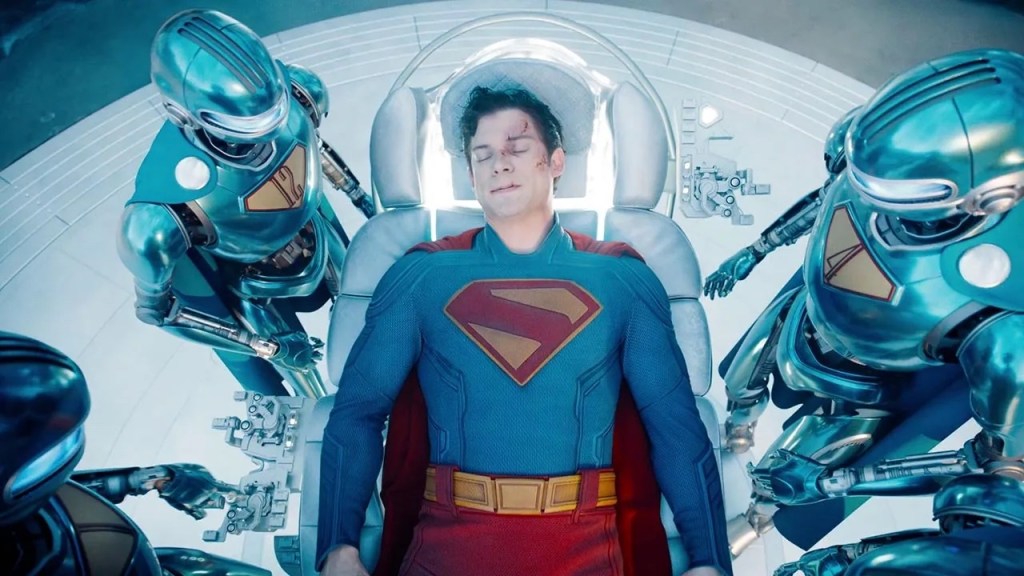
Some might feel like this Superman is a bit too goofy. He wears his trunks on the outside of his costume (which is the best design, even if it looks silly). He built robot companions for himself. He fights giant monsters. And perhaps most controversially, this Superman has a dog. A superpowered dog named Krypto. It’s impossible to be a grim and serious drag when a dog wearing a cape is flying around the screen.
Gunn really toes the line with how much Krypto is in this movie. But it’s not just for comic relief or an attempt to appeal to kids. Krypto serves a storytelling purpose, and more importantly, he helps explain Superman’s character. He hasn’t trained this dog well, presumably because he’s busy. But Krypto also helps Superman feel less lonely because he’s from Krypton.
Superman also shows how human he really is when he fears that his innocent companion has been harmed. It’s another example of how much he cares. In Superman II (1980), Christopher Reeve pleaded with Terence Stamp’s General Zod not to hurt people. Here, he gets pissed when he believes Lex Luthor has hurt his dog. He scolds fellow superheroes for not neutralizing a threat more humanely.
This 2025 Superman isn’t one we’ve typically seen on the big screen. He’s vulnerable and relatable, which is portrayed very believably by David Corenswet. The story begins with Superman having a really bad day and needing to recuperate. Who can’t empathize with that?
That’s a problem many creators and fans have faced with the character. It’s difficult to connect with a hero when machine gun tracer rounds or a bullet to the eyeball don’t even make him flinch, as in 2006’s Superman Returns. Incredible? Sure. But not so compelling. This Superman gets beaten up. He makes mistakes. He shows rash judgments.
Gunn also places his Superman squarely in our current world. Not by showing how the world might react to him, as Zack Snyder did in Man of Steel (2013). In Snyder’s deeply skeptical view, people had to prove to Superman that they were worthy of being helped and protected. This new version of Superman has to prove to people that he’s genuinely good, often battling the cynicism of political commentary and social media. Gunn clearly has some strong feelings on that.
Yet as resonant as character and setting might be in this movie, the story doesn’t work as well because it has so much to carry. Gunn knows he doesn’t have to retell Superman’s origin, so he can start with the exciting stuff right away without spending half of the movie setting up the mythology. That might be jolting to some, but invigorating to others who realize they won’t see the same thing again.
The movie puts a lot into its box, probably to the point where it’s overfilled. It might be too much with the superpowered dog, monsters, other already established superheroes, and supervillains that provide formidable (and necessary) adversaries for Superman. He gets involved with international conflicts and geopolitics. And he goes to a secret dimension — unfortunately, the weakest, most incoherent part of the movie.
All of those ingredients are in addition to the familiar components of the Superman mythology that Gunn respectfully includes, but also revitalizes with new takes on the characters.
Lois Lane (Rachel Brosnahan) isn’t just a great reporter and bold personality. She challenges Clark Kent’s worldview, fills in gaps that his upbringing created, and speaks up when he won’t. Jimmy Olsen (Skyler Gisondo), a character that Snyder had no use for in his films, arguably does the most journalism work in the story, which also provides the biggest laughs. Jonathan (Pruitt Taylor Vance) and Martha (Neva Howell) Kent are the wholesome Midwestern parents who helped form Clark’s sense of right and wrong.
Then there’s Lex Luthor (Nicholas Hoult), who is smarter and more evil than any version portrayed before. He’s the mad scientist and master strategist from the comic books, brilliant but unhinged enough to make everyone around him afraid. As villainous as Gene Hackman and Kevin Spacey may have been in their interpretations, they also had jokey undertones. Hoult’s Luthor is ruthless with envy and actually seems capable of defeating — and killing — Superman.
The other superheroes included in the story might feel excessive. But Mr. Terrific (Edi Gathegi) becomes a valuable ally who brings style and intrigue to this DC movie universe. He needs to be seen more, whether in other movies or his own TV series. Guy Gardner/Green Lantern (Nathan Fillion) thinks he’s a hero because he’s more powerful than regular people, a very different view from Superman’s.
All of these pieces form a rich world around Superman that creates promise for what’s to come in other DC films. Yet there’s no feeling that this is only one chapter of a story setting up other movies down the line, an important factor that has bogged down many recent Marvel films. No homework is necessary beforehand, no studying is needed afterward.
Some might feel that there’s just too much happening here, especially for a new introduction to Superman. But this is how Superman comic books felt in the 1960s and 1970s, before many of those elements were stripped away in the 1980s to make the character simpler to new audiences. That’s no longer necessary for an audience that’s been watching superhero movies for 20-25 years.
Filmmakers don’t have to be embarrassed by the hokey elements of these characters. Gunn most certainly isn’t. He has fully engaged with what he loves about superheroes and their stories, which he demonstrated with his Guardians of the Galaxy movies and The Suicide Squad. It’s all weird. Many of the deeper cuts from comic book mythology are very weird. Yet that’s what makes these stories special. And it’s what makes this new Superman stand out when it’s needed most.
 Ian Casselberry
Pingback: ‘The Fantastic Four: First Steps’ feels fresh, but takes too big a first step toward the MCU | Ian Casselberry
Pingback: Watched ‘em, read ‘em: July 2025 | Ian Casselberry